Supporting citizen-centered care for seniors – our paper at CBMS 2012

In June I participated in the 25th International Symposium on Computer-Based Medical Systems (CBMS 2012) in Rome, Italy. It was my first time at a CBMS conference, and at times I got a bit lost in the more technically focused sessions, but I had a great time!

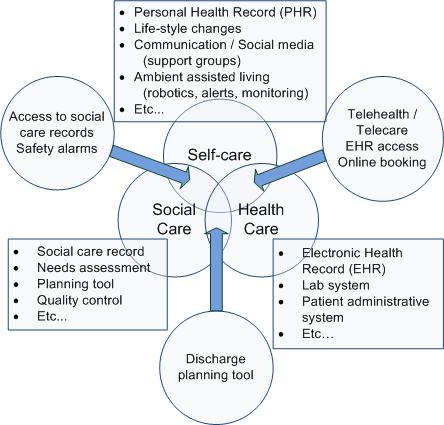
The session I participated in was a special track on “Informatics challenges of patient centric health and social care”. My paper is entitled Supporting citizen-centered care for seniors – experiences from two Swedish research projects. The paper draws on our experiences from two projects; Old@Home and VIP-PA. I’m not gonna give you a full summary of the paper, but the results of our analysis indicate the importance of addressing the intersections of health-, social- and self-care when developing ICT solutions to support long-term care in an aging society.

Figure from Hagglund, Scandurra, Koch “Supporting Citizen-Centered Care for Seniors – Experiences from Two Swedish Research Projects” DOI: 10.1109/CBMS.2012.6266377

Posted in Uncategorized | Tagged , , | Leave a comment

Poor continuity in my blogging

Apologies for not updating my blog recently. In Sweden, what happens in July is that everyone goes on vacation and no work is done for months… for me, it lasted a bit longer this year as we all of a sudden were offered a new house and decided to move! But now I’m back! So keep a look out for my next health IT related post…

Posted in Uncategorized | Leave a comment

Poor continuity in Swedish healthcare

I recently read a Swedish blogpost with the title “Recovery stops when patients are discharged from healthcare” (in Swedish). Sweden participated in an international evaluation “International Health Policy Survey”, and the results show that Swedish healthcare ranks low on areas regarding continuity of care and coordination. I’m not surprised (and neither is the representative from the board of health and welfare commenting on the results). I have worked within homecare of elderly and stroke patients, and the dominating experience is that as long as the patients are in hospital everything works relatively well, but after discharge chaos sets in. Many different care providers are involved, without proper communication and information sharing tools and patients and their family carers are left to try to navigate the muddy waters of primary care and social services as best they can. As expressed in the article above, the support for patients’ continuous self-management (with the help of family or social services) is also very low.

From a health informatics perspective there remains a lot of work to be done to adapt the monolithic and profession-centered health information systems to a team-based, collaborative healthcare environment where continuity of information can be provided and where all members of the team (including patients and family carers) have adequate support for their activities!

Posted in Uncategorized | Tagged , | Leave a comment

Research crossing boundaries

Today a blog post I wrote a while ago for a Swedish life science blog was published. As it is in Swedish I figured I might as well translate it and publish it for you here to! So enjoy:

Research crossing boundaries

I often think of my health informatics research as crossing boundaries. There are so many boundaries within healthcare today, and through my work I try to create continuity across these boundaries using information and communication technology (ICT). Here, I would like to discuss some the boundaries my research focuses on.

The boundary between healthcare and social care – as we live longer there is an increasing number of individuals requiring both healthcare and social services such as public or private home help services (i.e. aid with housekeeping, cooking and personal hygiene). Different legislation govern the documentation and use of health related information in these areas, but the need to coordinate and communicate across the boundaries between healthcare and social care organizations is increasing for many patient groups. To what extent should information be shared between healthcare and social services? How can new ICT solutions be developed to provide control over information sharing and empowerment for care recipients?

The boundary between care providers and care recipients/patients – having access to information is considered a source of power; to be able to make informed decisions about my own health I as a patient/citizen demand direct access to my health related information. But how does this progress affect the design and implementation of health ICT? How can the work tools that care professionals use change to meet the new requirements? How will this affect how healthcare is organized? How will roles and responsibilities be changed – e.g. what role will family carers play when it comes to information access and decision making in a future where patients are given increasing access to and control over their own health information?

As new technology is introduced which creates new possibilities for both care providers, care professional and patients/citizens issues regarding where the boundaries are and who has control over information flow are accentuated. Questions that are debated in Sweden today concern the responsibility for preventive care and support in life-style change, the patients access to their health records (should the patient be allowed to read everything and who determines where the line should be drawn?), and how should information be shared within and between care provider organizations?

I hope that my research can provide answers to a few questions, and I’m sure it will create a few more… but the important thing is to keep asking the right questions!

Posted in Uncategorized | 2 Comments

Inspirational walker

Health is a delicate thing. One day you have it, the next day you don’t. But there are many things we can do to try to hold on to it as long as we can (although changing bad habits is notoriously difficult, more on that another day). I am an eager twitterer and on twitter I follow the documentary film maker Michael Moore (@MMFlint), not because I thought he would have interesting things to say about health informatics, but because I think he’s an interesting person. To my surprise, he turned out to be a great health inspiration!

MMFlint

Michael Moore twittered about the rise of anti-depressant medication in the US and was wondering why everyone was feeling so bad. He got a reply from someone saying if people just went for a walk everyday they would feel better and not need so much medication. Now, the US may not be known for encouraging walking, so Mike took this as a challenge, and has started to go for a walk EVERY DAY. Here’s a storify link to how it all got started: http://storify.com/lhighfill/miketakesawalk He also twitters about it and encourages everyone to walk with him, look up #miketakesawalk #Iwalkwithmike

This has turned into quite a movement, and it’s a real inspiration to me! Living healthier doesn’t have to be that hard. And social media can both motivate and trigger healthier behavior. So, tonight I’m going to go for a walk – are you with me?

Posted in Uncategorized | Tagged , , , | Leave a comment

Room for research

Today we went on an excursion to our new office building which is being built on campus. It’s very much a construction site still (we’re not moving until next year), but we got to see how big the offices are going to be and some of the lecture halls… it made me think about what an optimal work space is. Right now I share an office with two other researchers, and come to think of it I have never actually had MY OWN office. But I like sharing a room. Maybe it’s just that I’m used to it… I do also work from home 1-2 days/week, so when I’m actually at the office I enjoy spending time with my colleagues. So choosing between a room just for me, a 2-person room and a larger room for 4 is difficult. We’ve had a lot of discussions, and most of my colleagues feel that they need the privacy of a single room to be able to focus and get their work done and that a bigger office is only used to save money. Personally, I don’t really agree. I think it can actually help creative thinking and stimulate discussions and progress to share an office. Plus it’s fun (depending on who you get to share with I guess). So I’m actually leaning towards the 4-person space.

What would you choose?

Posted in Uncategorized | Tagged , , | Leave a comment

What’s health to you?

Health Informatics is my field of research. Both words have different associations for different people, and lately I’ve been thinking a lot about health – what does it mean to me?

The World Health Organization defines health as “a state of physical, mental and social well-being and not merely the absence of disease or infirmity” (Consitution of the World Health Organization, 2006), and this defintion resonates with me. Often when we speak of health, we focus on the physical aspects, especially when involved in healthcare and medicine. My own personal experience tells me that the three aspects mentioned by WHO (physical, mental and social well-being) are so closely intertwined it’s almost impossible to address one aspect without also affecting the others. Excercise and healthy eating habits will make you feel better not only physically, but also mentally. If you are unhappy in your social life it affects your motivation to preserve a healthy lifestyle negatively. Bad habits (that affect our physical, mental or social well-being negatively) have  a tendency to create negative spirals; if I eat junk food I don’t have the energy to exercise and I end up on the sofa watching TV and eating more junk, feeling really bad about myself… and the other way around. Now, it’s of course each individuals personal responsibility to live a healthy life, but we all know that changing bad habits can be difficult. A topic I’ve found more and more interesting lately is therefore; how can we use new technology (since I’m an informatics researcher too)to create a space for collaboration where healthcare and individuals can meet and find support for health promotion and behavioral change?

I will return to this in the future…

Posted in Uncategorized | Tagged , | Leave a comment