The importance of a shared meal

Food is important to me. I think everyone who knows me can vouch for that. I don’t know if people can be categorized into those that eat to live and those that live to eat, but I would probably belong to the latter group. I take great pleasure in a well-prepared meal, and sharing food or drinks with family and friends is essential to me.

When my father spent two weeks in the hospital, he was given surprisingly good food. We couldn’t really share meals with him though. And I hated that. Being able to prepare and share food together is part of being a family for me.

While my father was on his cancer medication (Afinitor) he also lost his appetite. He didn’t get sick, but he got bad mouth sores and “everything tasted like cardboard”. It made meals more of a painful experience, where we were all carefully monitoring him to make sure that he was eating enough.

Now, he’s back home from the hospital and off the Afinitor (as it caused pneumonitis) and his appetite is back. He’s trapped upstairs though with his hospital bed, favourite chair and oxygen and we’ve always had our meals downstairs… so these days, we’ve taken in a fold-out table and some chairs that we keep in the hall, and for breakfast, lunch, dinner we set them up and share our meal. Yesterday I made a potato gratin with ham, and today we’re having broccoli soup.
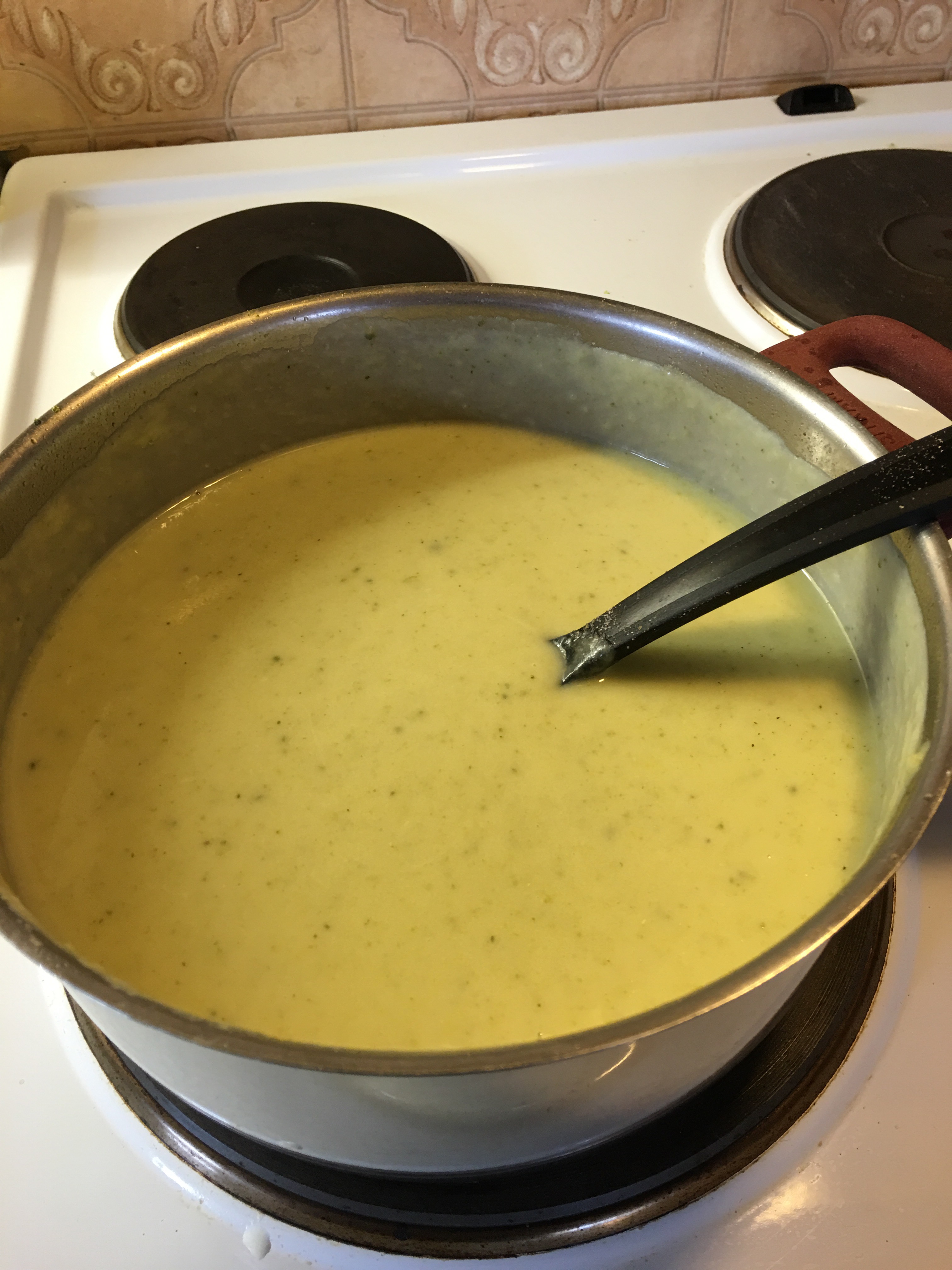
soon to be served broccoli soup


To me, preparing these meals for us is my way of expressing love and support and it’s equally important as keeping track of doctors appointments, insulin levels and complex medication schedules.

[post 36 in the #blogg100 challenge]

Posted in Patient experience | Tagged , , , | Leave a comment

The story of illness

I’m a researcher in health informatics – but growing up, what I always dreamed of was being an author, a storyteller. As a researcher, I of course get to write. And write, and write. But the storytelling is seldom in focus. Rather – we tend to focus on academic writing, structured data, and information models, and reuse of medical data. Perhaps this is why I enjoy social media and blogging as more of a creative outlet.

I guess my love for storytelling is also what has drawn me towards working with user experience in healthcare, and patient experience in particular. I take pride and pleasure in trying to understand and communicate the stories that people entrust me with, whether I’m working with lung cancer patients, stroke survivors or assistant nurses in homecare of elderly. What can we learn from these that will help us better design health informatics soluations?

With my more recent experience of travelling with my father through his cancer journey, the meaning of storytelling has grown. The importance of being able to tell your story. Of having someone hearing it. The therapeutic effects storytelling has, and the dire consequences of stories unheard. This fall, I will help organize a 1-day conference on Narrative Medicine in Stockholm, and leading up to this event I will have plenty of opportunity to explore what storytelling means to patients, caregivers, healthcare professionals – and to designers of health informatics solutions.

I would like to begin by sharing a TedX talk entitled “Honoring the stories of illness” by Rita Charon, the executive director of the Program in Narrative Medicine at the Columbia University Medical Centre.

[post 35 in the #blogg100 challenge]

Posted in Consumer Health Informatics, Narrative medicine, Patient experience, Social media | Tagged , , , , | 2 Comments

Academic rewards

I’ve had a couple of rough days (weeks? months?) and when life starts messing with you all of a sudden it becomes much harder to cope with the huge work load as well. I usually don’t have a problem juggling research projects, teaching, board work, supervision and being a director of studies (at least not big problems), but this year’s been hard.

And just when I started to think “is it really worth it?”, I got this wonderful thank you letter in my office mail box. It reminded me of what a privilege it is to work as an academic.
In September last year I was the first opponent at a dissertation in Norway. It’s of course a lot of work you need to put into this, but you also get to be a part of one of the most important days of another persons life – and not just the actual dissertation, but you get to join in the celebrations as well and meet family and friends who have all supported the PhD student through this journey. It’s really an amazing experience!

So, thank you, Jorunn, for letting me be part of your disputas! And for reminding me of the rewards of being an Academic.

[post 34 in the #blogg100 challenge – I’ll keep counting and see which number I’ve reached by the time the challenge officially ends…]

Posted in academic life, Dissertations | Tagged , | Leave a comment

Lifelines

I sneak by the room where you sit in your favorite chair – I don’t know if you’re sleeping.

I don’t want you to see I’ve been crying. Again.

I step carefully over the plastic tube that gives you oxygen.

It’s a lifeline and a snare – keeping you trapped, letting you breath.

I brush my teeth and get ready for bed.

Keeping my game face on.


Listening to the oxygen pump with its rhythmic heartbeat, strangely soothing.


[post 33 in the #blogg100 challenge]

Posted in Patient experience | Tagged , , , | Leave a comment

Addicted to ToDo-lists

At times like these, when I simply don’t know where to start because I have so many things to do, I make lists. On little pieces of paper, on the back of reports I’m reading, and more recently in the online tool Wunderlist.

Even if the list becomes very long (and honestly, quite stressful) – it gives me structure and order and it’s a way to prioritize what to do next. It calms me down. And the satisfaction of being able to cross a post of as DONE is so satisfying. So, now I’ve spent half-an-hour updating my ToDo list and I have managed to prioritize 9 things that really ought to be done by monday. Blogging is not one of them, but try to keep me from it!

[post 32 in the #blogg100 challenge]

Posted in academic life | Tagged , | Leave a comment

Physician Adherence

This amazing facebook post by equally amazing Hugo Campos deserves a blog post all to itself. Enjoy!

Adherence

Hugo turns the table on the old, worn out terms “compliance” and “adherence” which are usually used to describe patients and their behaviour – and what’s not to love! I hope all doctors out there feel equally offended by being described as compliant or non-compliant as I do!

If you want to learn more about Hugo Campos, Stanford Medicine X ePatient Advisor and White House Champion of Change for Precision Medicine, have a look at his TedX talk:

[post 31 in the #blogg100 challenge]

Posted in Consumer Health Informatics, Patient experience | Tagged , , | Leave a comment

Is ignorance bliss?

I find that going through a cancer diagnosis and treatment process is making me very ambivalent to “finding out”. I know I’m strongly arguing for access to ALL information about your health and healthcare – but it’s sometimes with mixed feeling. While waiting for news between all the diagnostic examinations I listened to a song by the Swedish singer/songwriter Sophie Zelmani, and for me it really captures the ambivalens of waiting for the diagnosis/news of tests and lab results and x-rays… the song is probably about some other bad truth, but for me – it’s now all “cancer truth”:

I don’t wanna find out the truth
But only truth satisfy

I want it so much to go away
But with the truth it will stay

And you will fall heavy upon my chest
But laughing will give the time to rest
I still can breathe when you are asleep
Just let me gasp for peace

I’d like to have other things on my mind
Like to have other things on my mind
I can’t choose a lie

I wanna wake up and find you
If it’s true, I won’t continue to

You will fall heavy upon my chest
But laughing will give the time to rest
I still can breathe when you are asleep
Just let me gasp for little peace

I don’t know how to get armed
Truth is hard to charm, so hard to charm

There are times when I just want to cover my eyes and ears and not take in any more information at all – it’s seems all we’re ever getting is bad news. But I guess it’s in my nature to still want to know – “only truth satisfies”, and having spent almost all my life in an educational and research environment, I’m constantly learning. It’s part of my coping strategy to find out as much as I possibly can. And perhaps, sometimes ignorance is bliss. When it comes to your health and healthcare though – ignorance can be very dangerous.

I think however, that this can also be part of the reason why healthcare professionals sometimes hesitate to provide all information to patients – they get to be the (constant) bearer of bad news when what they really want to do is save and cure and help. And when we are faced with terrible news – who is easier to accuse, be angry with, and blame than the bearer of those news? The person I’m chasing to get all the information, and then when I get it it’s really not what wanted to hear… is it surprising that some of those negative feelings gets associated with the information bearer? What are your experiences?

[post 30 in the #blogg100 challenge]

Posted in Uncategorized | Leave a comment