Blog restructured

Today I’ve made an important blog decision. I have removed the static page called “Conferences”. I had some naive idea that I would be able to keep an updated list of conferences in Health/Medical Informatics and perhaps even reflections from the ones I’ve visited – but honestly. How could I keep up?

There were only 3 conferences there, and they were from 2012, 2013… embarrassing. So, it had to go. Instead I’ll use the conference category to mark regular blog posts, and if you’re interested in finding conference info you can find it there!

[post 15 in the #blogg100 challenge]

Posted in Health Informatics conferences | Leave a comment

World leading by 2025 – a new Swedish eHealth vision!

År 2025 ska Sverige vara bäst i världen på att använda digitaliseringens och e-hälsans möjligheter i syfte att underlätta för människor att uppnå en god och jämlik hälsa och välfärd samt utveckla och stärka egna resurser för ökad självständighet och delaktighet i samhällslivet.

[MY TRANSLATION: In 2025, Sweden will be world leading at utilizing the opportunities of digitalisation and eHealth to help individuals achieve good and equal health and welfare, as well as develop and strenghten indiviuals own resources for increased independence and participation in society.]

That’s what the Swedish National eHealth Vision that was published today states. And I’m ready to contribute!

I will certainly return to this vision statement in future blog posts, but I have an application for research funding to complete today…

[post 14 in the #blogg100 challenge]


Posted in #blogg100, Uncategorized | Tagged , | Leave a comment

PhD parenting

I started writing this post last year as I was taking the MOOC “How to survive your PhD“. I quickly got engaged in online discussions about the struggles of getting your PhD and keeping your sanity. I worked on my thesis between 2003 and 2009 (I defended my thesis in February so it’s been just over 7 years now), and in retrospect I think that my PhD student time was among the best years of my life. I had so much fun, met so many amazing persons and got to travel the world for conferences. But of course it was difficult too. I guess you just tend to forget those things looking back… kind of like giving birth.

Speaking of which, one topic that almost immediately came up during the MOOC was – being a parent and a PhD student. So, I promised I would share some of my experiences in a blog post (tweets are simply not long enough). It took me roughly 9 months to complete the post, but hopefully it’s worth the wait…

When I started my PhD I was 28 and extremely single. I spent more or less all my time at work, and I was quite happy to do so! One of my very best friends (the amazing @isadurraon twitter) got accepted as a PhD student at the same time and we worked on parallel topics – so I was never isolated in my work as I hear many others experience.

Anyway, about halfway through my PhD I fell head over heals in love and it wasn’t long until we moved in together and less than a year later we realized we were going to become a family. Not really planned, but very welcomed. There was never any question of quitting the PhD – we have excellent parental leave in Sweden and daycare is great. But I was nervous about telling my supervisor. I could tell she worried (as probably any supervisor would) but being the excellent person she is we quickly had a plan made and I could continue to focus on work.

I took about 4 months off work completely when my daughter was born, but if my memory doesn’t fail me, I think I managed to resubmit a paper for publication while she was sleeping. When she was 4 months, I started working about 20% – taking a course as part of my PhD education. Most of it I did from home, but during lectures and meetings I would either take her with me or my husband would stay with her (as he did quite a lot). All in all, I took about 12 months off, delaying the PhD somewhat. All worth it though.

Since then, I’ve continued to work full time with research and higher education, and in 2010 my son was born. This time I took 6 months off – and then started working full time again while my husband stayed at home a whole year. This worked very well too.

If I was to give any advice about combining PhD and parenting it would probably be:

  1. Make sure you have a good partner – someone who’s willing and able to share the responsibility and who will understand and be patient when you stress out over research (as you are bound to do from time to time). But remember to not take this person for granted.
  2. Make sure you have good daycare – I know I’m spoiled living in Sweden with excellent parental leave and daycare in place. I can only recommend it.
  3. Cut yourself some slack – you don’t have to be the perfect parent (or partner) everyday. Or the perfect PhD student. And you definitely don’t need a perfect home. This is especially important for all PhD mothers – there are so many unspoken requirements that we put on ourselves. Try to let them go. The world won’t end because the windows are still not washed and someone should have cleaned the bathroom last week. Drop the guilt.
MedInfo2010 måndag 2010-09-13 008

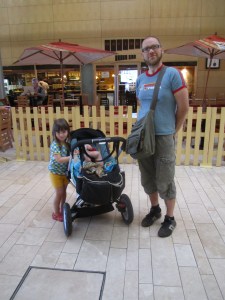
Quick visit from the family at the conference centre MedInfo 2010, Cape Town

And remember, there are many benefits of combining research with parenthood too! The work hours are often flexible, which means you can probably leave work earlier sometimes, or even work from home one or two days/week which really helps with all the practicalities. There can be quite a lot of travelling when presenting your research at international conferences – which has always been a great bonus to me. And I try to bring the family as often as I can (at bit more difficult now that the kids are bigger and need to be in school). When my daughter was 10 months we went to 2 conferences in Australia – had a great time! And when she was 4 and my son 10 months we went to a conference in Cape Town – which was also excellent. Not only do you get to share some amazing experiences with your family, it’s also some compensation for your partner who has to put up with all those late nights working against paper submission deadlines.

[post 13 in #blogg100 challenge]

Posted in #blogg100, academic life | Tagged , , | 1 Comment

To my best friend, partner and constant support

Thank you, Mattias.

Thank you for being stable when I doubt.

Thank you for being patient when I second guess.

Thank you for never, ever complaining when I stay up late at night writing research proposals, writing papers, grading exams. Without you, I would never have been able to cope with it all.


DSCF8984

On our wedding day – (almost) the beginning of a wonderful journey

Thank you for creating the two most amazing little persons with me, and

Copy (2) of IMG_1069

Ester and Emil 2012

for being a great dad.

Thank you for always doing the laundry (which I never have time to) and vacuuming (which I hate). And for cooking. And for binge watching TV-series. And for not complaining when I insist on watching things like Desperate housewives or Gray’s anatomy (except for the occassional “shoddy writing”-comment).

Thank you for daring that first kiss despite my warnings of starting something we wouldn’t be able to control. Oh, and thanks for putting up with me being a control freak.

Thank you for always making me laugh, even when things are really bad. And for just holding me when there is no laughter to be found.

Thank you for writing poetry that I sometimes don’t understand, and that sometimes rips my heart out and takes my breath away. Thank you for all the short (and longer) stories in which we meet and fall in love, over and over again.

And Happy 40th Birthday!

Posted in #blogg100, Uncategorized | Tagged | Leave a comment

Giving patients online access to their EHR – interview with Benny Eklund

I’ve written before about patients online access to their Electronic Health Records in Sweden, and this is a topic that is very dear to me – I will without a doubt return to it often. Last year, me and my colleagues at HIC created a MOOC (Massive Open Online Course) on the edX platform, and as part of this course I interviewed some important eHealth stakeholders in Sweden. One of them was Benny Eklund who has been a driving force in Sweden to achieve patients’ access to their EHRs – starting with local projects in Uppsala already in the 1990s. He was the project coordinator of the EU project SUSTAINS under the 7th Framework Programme.

Here are the interviews – which also include a demo of the patients view of their EHR! [As a bonus, you get to both see and hear me – lucky you!]

In the second video, we discuss more of the challenges and hurdles that have had to be overcome to reach as far as we now have in Sweden.

What do you think? Is this a good development or too risky? I would love to hear your opinions – and perhaps have a discussion – in the comments below.

[post 11 in the #blogg100 challenge]

Posted in #blogg100, Consumer Health Informatics | Tagged , , , | 1 Comment

Patient EmPOWERment – what do we mean?

I’ve written before about my PhD student Sara Riggare who is focusing on how health informatics and new technology can help patients to take control over their health and collaboration with healthcare. In this podcast, she discusses the concept “patient empowerment” in Swedish. There’s no good direct translation of the term patient empowerment to Swedish – and in the podcast the topic was “patientmakt” = patient power. Sara however proposes to use the term “patientkraft” instead, which also translates to patient power. I believe that these to terms for power in Swedish clearly shows the double nature the term empowerment has.

Makt – is often related to having power over things, e.g. a leader that has risen to power, or to be power hungry.

Kraft – on the other hand is more positive (in this context), relating more to energy and strength, having the power to handle difficulties.

Both terms can be relevant when discussing the concept of patient empowerment. There is definitely a question of makt in place in the relationships between healthcare professionals and patients. Going from a traditional paternalistic relationship where the healthcare professionals (doctors in particular) have all the power and  knowledge and makes decisions for patients, to one where patients are given the power over decisions and should be informed in order to do so is easy to accept in theory, but definitely causes conflict in reality. Shifting the power balance is difficult without controversy.

Speaking of “patientkraft” – the power or energy patients have to take responsibility and manage their own disease and healthcare – has a much more positive ring to it. It also focuses more on a collaborative relationship between patient and healthcare professionals, rather than a conflicting one where power is taken from one part and given to the other. With the term “patientkraft” we move closer to the often repeated quote: “Patients are the most underutilized resource in health care”.

The way I see it, both aspects of patient empowerment, both MAKT and KRAFT, are essential to understand the potentially disruptive nature of patient empowerment.

[post 10 in the #blogg100 challenge]

Posted in #blogg100, Consumer Health Informatics | Tagged , | Leave a comment

How has smart patients helped you?

This blog post will be both personal and professional. Perhaps mostly personal, but since this is also my field of research I can’t help but reflect. But let’s start with the personal.

A few days before christmas, my dad started coughing blood (after suffering a “bad cold” for months) and was sent to the emergency room. He was admitted to the hospital Friday night so that they could do an x-ray of his lungs. When he finally had the examination, it turned out it wasn’t a blood clot (as suspected) but cancer tumours. And lots of them. After being given this news, a bunch of referrals to different clinics and a prescription of mild pain killers – we were sent home. Needless to say, Christmas was not as usual. We quickly cancelled all other plans and stayed at my parents house. After everyone else had gone to bed (not sure anyone actually slept though), I stayed up reading everything I could about lung cancer online, ordered materials from the patient organisation Stödet, and searched for an online patient community in Sweden. And I couldn’t really find one.

Luckily for me, in September I went to the MedX-conference at Stanford, and there I met the amazing people at Smart Patients – “an online community where patients and caregivers learn from each other”.

Smart patients

Me, Sara Riggare (PhD student at Karolinska Institutet), Ron Zeiger (co-founder SP), and Johan Eltes (Inera). The picture was taken by Gilles Frydman (co-founder SP) at the Smart Patients office in September 2015

I quickly set up an account an had access to amazing support and advice from patients and family members who had been in the same position as me. I vented and despaired and they encouraged me and acknowledged the pain. Which was a relief. When we later on found the origin of the metastases, I moved to the kidney cancer community within smart patients, and found excellent information on medications, the clinical trial we were offered to join, alternative treatments – you name it!

Today I was asked to give som feedback on the Smart Patients’ services, and I thought I’d share my answer to the question “How has smart patients helped you?”

In several ways;

(1) support from people in the same – or similar – situations during difficult times. It’s a relief to have a safe space to share and worry and regain hope

(2) excellent advice – I get both answers to my questions, and recommendations as what to do/ask next.

(3) education – browsing other patients threads and using the “explanations” of abbreviations, medications etc is so helpful! Learning about important issues, but also terminology. Makes dialog with healthcare easier, and it also facilitates my own searching for information outside SP.

In summary, I recommend finding a good online patient community to anyone faced with difficult health issues. Not just for the support it lends, but also for all the knowledge you can gain – knowledge that can be essential to get through challenging times to come!

[post 9 in the #blogg100 challenge]

Posted in #blogg100, Consumer Health Informatics, Patient experience | Tagged , , , , , | 1 Comment