Working from home again today and I took the opportunity to browse through the latest issue of Universitetsläraren – a publication from SULF, a union for researchers and university level educators.
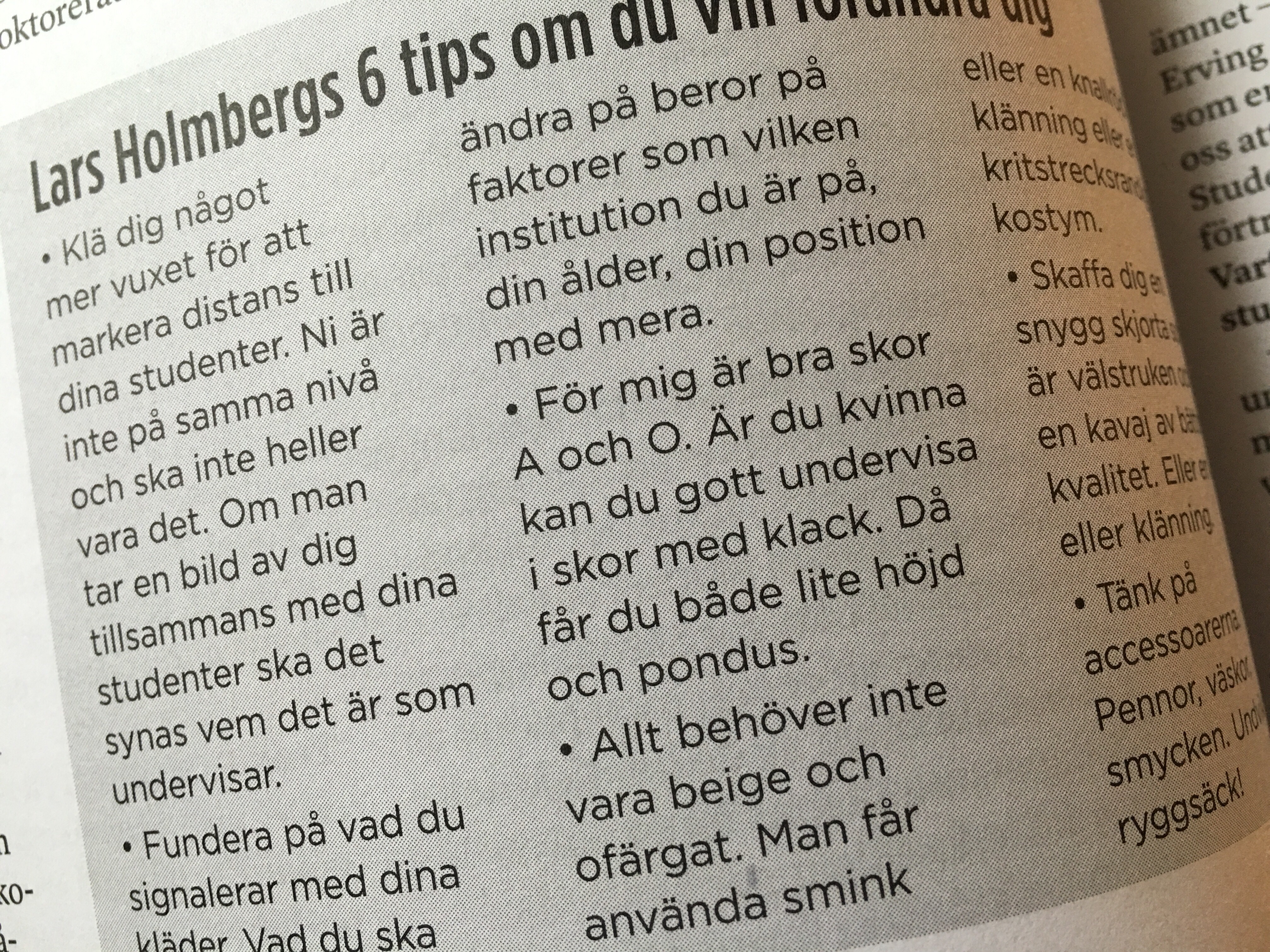
About half way through, I stumbled on an article called “Dressed for success – rätt klädd i undervisningen” and it stirred up some thoughts. Some of the advices were to dress more grown up, to signal a distance to your students – “you are not on the same level and shouldn’t be either”. I do make an effort to dress professionally when I’m teaching – but I also think that there is balance to keep here. There is of course some distance between faculty and students, but teaching at an international master programme means I will have students that are older than me and have more experiences from certain areas than I do. Although I’m the expert in my field, I want to express that there is mutual learning going on in our dynamic classroom and I don’t have monopoly on knowledge.
What provoced me even more though, whas the statement below, roughly translated into “For me good shoes are essential. If you are a woman you can definitely teach in high-heeled shoes. That will give you some height and authority”. What?! Sure, with my 160 cm I might benefit from heels for height purposes – but have you tried standing up all day in a pair? If good shoes are essential – I assume you mean shoes that are functional and proper looking – but heels? For height and authority. Admittedly, I used to wear heels for special occassions – but I’ve given up on it. Too much pain, not enough gain. And if my authority sits in my shoes I’m doomed anyway…
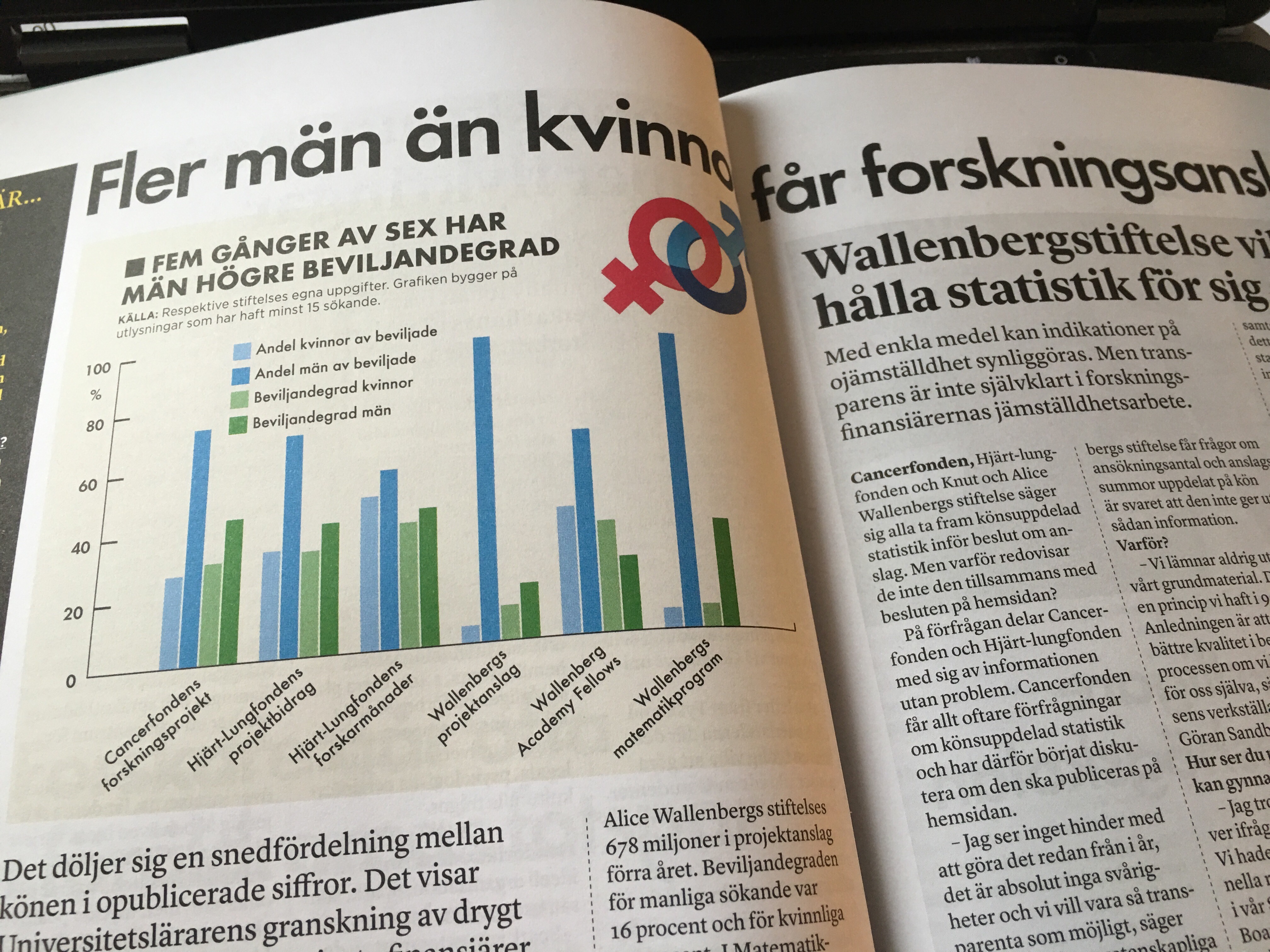
Just a few pages earlier in the same journal, I also read a very interesting article about gender distribution of research grants. 5 times out of 6 – male applicants were more likely to be awarded funding than females. I can’t help but wonder if it has to do with height and authority. Perhaps wearing heals while writing my next application will help? If I attach a picture?
Today it’s hard to write a blog post that does not focus on the tragic events in Brussels. It’s hard to find the right words though – any words at all actually.
But I will follow up on yesterdays blog post – about the benefits of using twitter as an academic – and briefly reflect on the role of social media when things like this happen. I myself first realized something had happened in Brussels from twitter – and quickly found out more from other news sites.
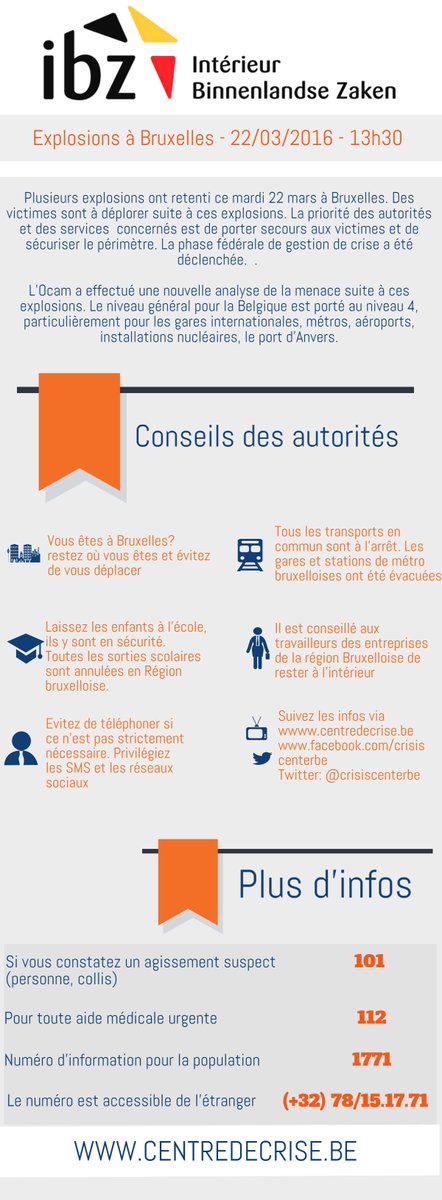
The Belgian Federal Crisis Centre e.g. keeps their web page up to date, but also continuously tweet important information for everyone in Brussels and outside (in many languages!):
They use this info graphic with contact information, and instructions (e.g. to stay at home, and to let children stay at school) to guide people through this crisis. One recommendation is e.g. to avoid using the telephone unless absolutely necessary, and to communicate using text messages or social media to let your loved ones know you are safe.
Frequently asked questions are also available in several languages, and refer to both facebook and twitter as important sources of up-to-date information.
Social media is today an essential means to communicate and spread information in crisis situations. This is of course not only relevant for terrorism and violence, but also for other situations such as natural disasters [1]. Yet another important reason to use social media, although one we can all hope we will not need to utilize in the future.
Apparently, Twitter turns 10 years today – and of course this deserves a blog post on it’s own. I joined twitter in september 2011 – and since then I’ve published 3320 tweets. Puh.
I thought this post would be a short reflection on the benefits of using twitter as a researcher or academic, but of course there are tons of great resources out there, like this five-part guide to using twitter from the Online Academic.
So this will just be a short personal reflection on the benefits I’ve experienced myself.
To have fun! I wouldn’t spend the amount of time I do on social media if I didn’t enjoy it.
To keep up with news. I often find out about things going on in the world on twitter first – and then I look it up elsewhere. This goes both for “regular” news and academic news. I’ll hear about new studies, interesting publications etc on twitter too. By following key people in my field I can also keep up with what they are doing, publishing, discussing…
To connect. It’s often easier to comment on a tweet and (hopefully) have a dialog than to send an email or pick up the phone. For me, being a bit of an introvert (at least IRL) it’s A LOT easier. I find it’s excellent at conferences – if you live tweet a session using the conference hashtag you’ll quickly pick up on who else is in the room tweeting – and it’s so much easier to approach them during the coffee break if you’ve already initiated a conversation through twitter. Pick a profile picture where they can recognize you though!
To engage the public. Being a researcher in health informatics, I’m in constant contact with patients, health care professionals, administrators, policy makers and politicians, IT vendors and many more important stakeholders that are not usually reached by my research publications or attending scientific conferences. Through twitter, I can extend my professional network well beyond the academic world. I’ve also experimented with using twitter to engage with the public before, during and after workshops held at academic conferences.
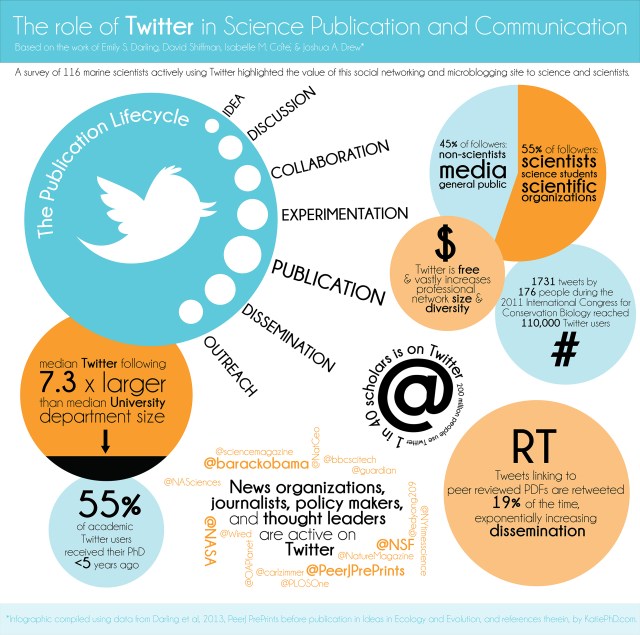
To promote your work. Once you’ve finally managed to publish a paper you’re of course dying for people to read it (and cite it!). But honestly, even if the paper is open access and in a good publication – the odds that it will reach your audience are not the best. Using twitter, you can take things into your own hands and spread the paper to your followers – and with a bit of luck they’ll continue retweeting it. Twitter isn’t just good for promoting the publication, it can be used throughout the publication lifecycle, as is shown in the infographic below.
Opportunities can also arize from your activities on twitter. I’ve been approached for collaborations and had journalists contact me to comment on issues that I’ve written about on twitter. Once, I even got a thank you from the conference organizers at the closing ceremony of a big health informatics conference (after having tweeted about the lack of acknowledgement of all the social media ambassadors tweeting from the conference that is – I didn’t realize the organizers checked the twitter feed while on stage).
To summarize, academic – go tweet! It’s so worth it.
Is the guitarr shop open on Sunday? How do you change the tier on the bike? What’s a good recipy for waffles? Where’s the best vegetarian restaurant in Nice?
Google it.
We all go online, constantly, to find out information we need. It can be as simple as finding opening hours, or to find instructions videos for doing something complex we’ve never tried before. Either way, there are boundless resources online to help us – some good, some not so good, but most of the time we manage to find out the things we want. It’s a huge difference from just 10-15 years ago, especially with the ever present smart phones. One might argue that life is a bit more boring when during any dinner conversation the answer to what year that movie actually premiered is only a few clicks away – but overall the benefits clearly overcomes any drawbacks.
There is one area, however, where searching for information is still controversial. Your health.
So controversial in fact, there have been national campaigns to try to stop people from googling their symptoms, and the topic is frequently discussed by health care professionals (and health informaticians) world wide. The main point being made that we are all just a few search terms away from convincing ourselves that we are dying from whatever rare and improbable condition we find in the dark corners of the web.
In February, a humouristic song was published on a leading journal for healthcare professionals in Sweden, and it stirred quite a discussion online, both at the website itself and on other forums such as facebook and twitter.
For me, personally, the song triggered many thoughts. I had spent the past weeks searching for information regarding my fathers cancer diagnosis and had learned so much more from the online sources (inluding the patient forum Smart Patients) than from the brief meetings with health care professionals. Despite their best efforts to explain everything, you are pressed for time, there are many practical issues to discuss, and frankly – your in chock and stressed out at every single meeting, faced with more and more (often bad) news that you have to process. It’s not until you’re back at home again that all those follow-up questions pops up – and then you have noone to turn to. Being in this position in life, I was provoced by the sentiment of the song, which to me seemed to mock the very human drive to find out as much as possible about what is going on with our health. So, what do we know about searching for health related information online?
Well, first of all – not everyone wants to! It’s a personal choice related to your coping strategies. Miller talks about “monitoring” versus “blunting” styles of coping with health issues and information relating to them [1]:
The research indicates that although some patients try to avoid or minimize obtaining stressful medical information, others seem to search for it and are highly sensitive to it. In the research on these processes, two basic modes of coping with medical stressors need to be considered. The first mode, monitoring (attention to, scanning for, and amplification of threatening cues), involves the extent to which individuals are alert for and sensitized to the negative, potentially painful, or dangerous aspects of information and experience. The second mode, blunting (avoidance of threatening cues), involves the extent to which individuals distract themselves from such information.
This resonates very strongly with me, and it also explains why we take such different approaches to information searching. I immediately want to find out as much as possible about my condition (or the ones my loved ones suffer from) – typical monitoring behaviour, whereas other members of my family choose to not search for information at all. Both are valid coping strategies (with benefits and drawbacks) – the important conclusion Miller makes is that healthcare needs to acknowledge the differences and adapt support to the individual patient.
Secondly, MANY people search for information online, for example, in the US, 51% of adults living with chronic conditions go online to find health-related information [2]. So is this good or bad? Well, a recent study from Australia indicates that a large number of online health information seekers have (at least some) difficulty in finding information and would like more guidance and support [3]. But is it dangerous? Finding studies that actually show patients coming to harm based on misleading information online and self-diagnosing is quite difficult. Many publications discuss the potential dangers of self-diagnosing, misleading information and poor health literacy, but few actually have evidence (please share resources in the comments below this post – I would love to have more references to this topic!). A study from 2003 e.g. states that parents “overwhelmingly positive impression of online health information suggests parents are unaware of the dangers of encountering misleading sources, an issue of special concern when considering the amount of influence this information carries.” [4]. The authors continue to call for more action from healthcare professionals to guide patients/family carers to “accurate online sources”. From my personal perspective, this is a very paternalistic perspective. I’m overall positive about the information I find online too – that doesn’t mean I believe ALL the information I find is correct – being a critical information seeker is essential – and these are the kind of skills everyone needs to learn, whether we’re looking for financial, political or health related advice online. However, I do agree that healthcare can take a much more active role in guiding and discussing online health information – please refer to good resources as a complement to the paper-based information handed out today!
So, my last remark in this post (but probably not on this topic – I’m bound to return to it later on), is KEEP GOOGLING! Don’t feel like your doing something wrong when you’re looking for health related information online – being well-informed and knowledgeable can on the contrary be essential! But keep a critical mindset. What is the source of this information? Who is behind it (and what do they have to gain from spreading this information/advice)? Are there other sources that can confirm or dispute the information? What consequences can acting on this information/advice lead to?
Speaking of Vitalis, I’m also organizing a workshop together with Johan Eltes, CTO at Inera. We will engage in an active discussion on how the current eHealth infrastructure can be used to facilitate implementation and spreading of eHealth nationally. If your interested – please sign up as space is limited!
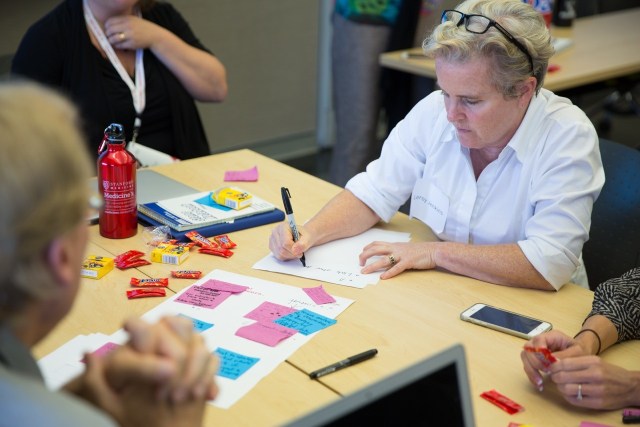
The workshop will be an adapted version of a workshop we held at the Medicine X conference at Stanford last year. After the very positive feedback we received there, we decided to give it a try back home too. Here’s a photo from the original workshop at Stanford, where Claudia Williams from the White House is busy generating innovative ideas for clinical research based on the Swedish health IT structure.
Claudia Williams from the White House is busy generating innovating ideas.
If your active within health IT in Sweden, you will have heard about the Vitalis conference. It’s held every year in Gothenburg – and this year is no difference. What’s new this year is that I will be presenting some of the results of the IntegrIT-project. And I won’t be alone. Before my presentation, Nina Sellberg will discuss the overall infrastructure we use to facilitate clinical research, and Dan Lind will describe experiences from the 4D project. So if you’re interested in what we’re doing to support and facilitate clinical research – don’t miss this session 8.30-10.00 2016-04-06!
[post 17 in the #blogg100 challenge – still 1 day behind]
Last week I was invited by the LET (Laboratory for Emerging Technologies)research group at KI to participate in a workshop and an afterwork (with beer) at the new H2 Health Hub in Solna. Naturally I agreed, and yesterday I joined a bunch of creative people and was going to share some of my experiences of accessing my own Electronic Health Record (EHR) as I’ve been able to do since 2012. I logged in before lunch just to refresh my demo flow and everything was working fine. At 14.15 (when I was supposed to live demo) it was not working AT ALL. I could log into my 1177.se-account and all was well until I tried to open the EHR (Journalen). All error messages and disaster. Spent 5 panicking minutes restarting, trying different browsers – you know, all you can do when a service suddenly crashes on you. Nothing worked. I hade to give up and resort to showing the interview with Benny instead (which was fine but not really the same thing as logging in live and sharing my own data).
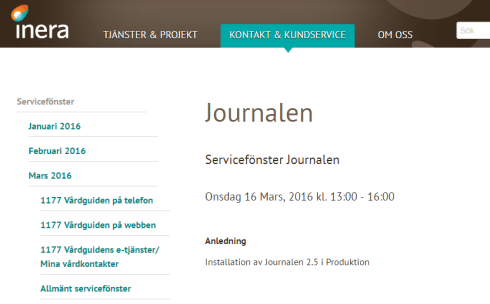
Later I found the following information on Inera’s web.
Turns out, the whole national service was shut down for service on the exact hours of the workshop. How unlucky can you be? At least I learned to check Inera’s web before agreeing to do live demos in the future. Yesterday, Inera – you were my personal Demo Devil…
[post 16 in the #blog100 challenge – posted with 1 day delay…]
Maria Hägglund is an Associate Professor in Health Informatics at Uppsala MedTech Science and Innovation, Uppsala University, Sweden. She has a PhD in Medical Informatics and worked at Karolinska Institutet 2009-2019 before returning home to Uppsala.



 Participatory eHealth